Skip to content

Learning elements

Built for learning, not just for content

Every element has a job: make people recall, explain, practise and get feedback.

The elements below are the real components a ULAMS course is made of. The ones a static page can run are live here; the rest open in a demo academy.

Practice and feedback

Recalling and explaining beats rereading. These elements make the learner do the thinking.

Practice question

Learning principle: Immediate feedbackLive

Answer, check, and read why: the explanation arrives right when it matters.

One question with an explanation; the result is said in words, never by colour alone, and nothing is recorded.

Try it yourself

A customer asks you to delete their exported data.

Under the privacy policy, how long do we keep customer exports?

Checking an answer needs JavaScript.

Graded quizzes

Learning principle: Retrieval practiceIn the learner player

Low-stakes testing makes knowledge last longer than rereading.

GIFT quizzes with one or several right answers, true/false, short answer, numerical, matching and essay questions, with retakes and a timer.

Try it in a demo academy

Self-test cards

Learning principle: Retrieval practiceLive

Say the answer before you look: recalling strengthens memory.

Front and back cards; the answer opens on a button, and without JavaScript both sides stay readable.

Key terms. Say the definition out loud, then check it.

  • Personal data

    Answer: Any information that identifies a person, directly or indirectly.

  • Data export

    Answer: A copy of a customer's data, produced on request.

  • Retention period

    Answer: How long we keep data before deleting it.

Worked example

Learning principle: Worked examplesLive

See a problem solved step by step before trying one alone.

A titled example in steps, used in lessons and in extra help.

Answering a deletion request

Step 1. Confirm who is asking: the request must come from the account owner.

Step 2. Check the policy: exports are deleted after 30 days.

Step 3. Reply with the deletion date and log the request.

Elaborative question

Learning principle: ElaborationLive

Explaining why in your own words connects new ideas to old ones.

An open question that asks the learner to explain, with an optional model answer.

In your own words

Why does a short retention period lower the risk of a data breach?

Reflection with AI feedback

Learning principle: ElaborationIn the learner player

Explain it as if to a beginner; the gaps show up.

The learner writes an explanation and asks for feedback grounded in the course's sources, labelled as AI.

Explanations that stick

Words and pictures together, in small steps, with structure the learner can see.

Formulas

Learning principle: Dual codingLive

Show the formula next to the words, so both carry the idea.

LaTeX in any text block, rendered as MathML that screen readers can read.

A quiz score as a share of the maximum:

s=pointsmax×100%s = \frac{\text{points}}{\text{max}} \times 100\%

Timeline

Learning principle: Chunking and structureLive

A visible sequence makes a process or a history easier to hold.

Dated steps marked done, current or upcoming.

A deletion request, step by step. What happens after a customer asks.

  1. Day 0

    The request arrives

    Done

  2. Day 1

    Identity confirmed

    Done

    Only the account owner can ask.

  3. Day 2

    Data deleted and logged

    Current

  4. Day 30

    Backups roll over

    Upcoming

Step-by-step reading

Learning principle: Chunking and structureLive

One part at a time keeps a long reading manageable.

A long text split into two to twelve parts, read in order.

Three rules for handling customer data.

Ask who it is

Confirm the account owner before you act.

Check the policy

The retention period decides what you keep.

Log it

Every request goes in the log with its date.

Figures and diagrams

Learning principle: Dual codingLive

A picture next to the text explains what words alone cannot.

Responsive images with a caption and click to zoom.

The lesson player of the coffee demo academy: the course outline on the left and a video lesson on the right.
Screenshot of the coffee demo academy, shown with the Figure component: click to zoom.

Video and audio

Learning principle: Dual codingLive

Short, signposted segments are easier to follow than one long take.

Video with a poster and chapter links, audio in the native player, and the transcript as text in the lesson; captions come from the author's file.

Try it in a demo academy

Interactive and hands-on

Scenarios, simulations and real tasks, played inside the lesson.

H5P activities

Learning principle: Scenario-based learningIn the learner player

Drag, match and explore: active tasks instead of passive reading.

Image hotspots, drag and drop, dialog cards and branching scenarios in the demos; H5P plays inside the lesson and its results feed learner insights.

Try it in a demo academy

Code exercises

Learning principle: Deliberate practiceIn the learner player

Write code, run the tests, fix, run again: practice with instant results.

JavaScript and TypeScript exercises with starter files and visible tests, run in a sandbox in the learner's browser.

ComingPython exercises and AI hints are coming.

Simulations

Learning principle: Scenario-based learningIn the learner player

Change a variable and see what happens: learning by exploring.

Interactive packages (3D scenes, maps, simulations) in a sandboxed frame, reporting progress to the course.

Try it in a demo academy

LiaScript lessons

Learning principle: Deliberate practiceIn the learner player

Text, quizzes and slides from one Markdown file, easy to keep up to date.

LiaScript courses played in a sandboxed frame on the content origin.

Try it in a demo academy

SCORM and cmi5 packages

Learning principle: Deliberate practiceIn the learner player

Reuse the e-learning you already have, with tracking intact.

SCORM 1.2 and 2004 packages and cmi5 activities, played and tracked on a separate content origin.

Try it in a demo academy

Projects

Learning principle: Deliberate practiceLive

A real task at the end turns knowledge into a skill.

A project card with a checklist; cmi5 activities use the same card.

Handle a real request

Take one anonymised request from last month and walk it through the policy.

  1. Confirm the requester
  2. Find the retention rule
  3. Write the reply
Open a demo academy

Try it in a demo academy

Support and evidence

Help when someone is stuck, and proof of what was learned.

AI tutor with citations

Learning principle: Help at the right momentIn the learner player

Questions answered from the course itself, with the passage to check.

Answers only from the course's sources with citations, says when a question is out of scope, never gives quiz answers during an attempt; off by default per academy.

Extra help

Learning principle: Help at the right momentIn the learner player

When someone keeps getting it wrong, a short explanation and one more try.

Personal, grounded help after repeated mistakes, with the reasons shown and an AI label.

Learner insights

Learning principle: Evidence of learningIn the learner player

See which sections confuse people and fix them, with evidence.

Per-course analytics of where learners struggle; an author can turn a confusing section into an improvement proposal to review.

Certificates

Learning principle: Evidence of learningScreenshot from a recorded run

A visible milestone that motivates and proves completion.

PDF certificates per academy with a verification page, QR code, expiry and recertification.
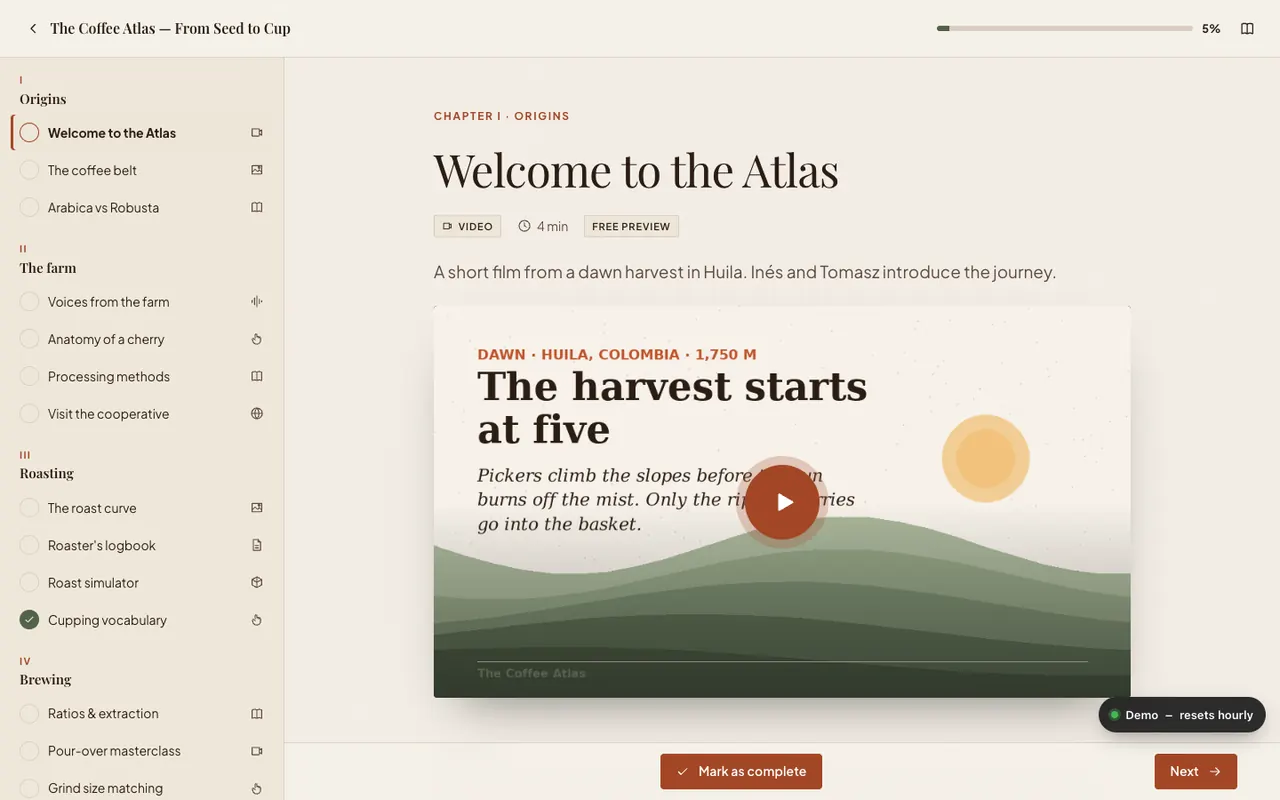
The finish page of the coffee demo course: what is still open and the certificate the course issues.
Screenshot from a recorded run

Try it in a demo academy

Courses that make people practise, not just read

The elements below are the real components a ULAMS course is made of. The ones a static page can run are live here; the rest open in a demo academy.